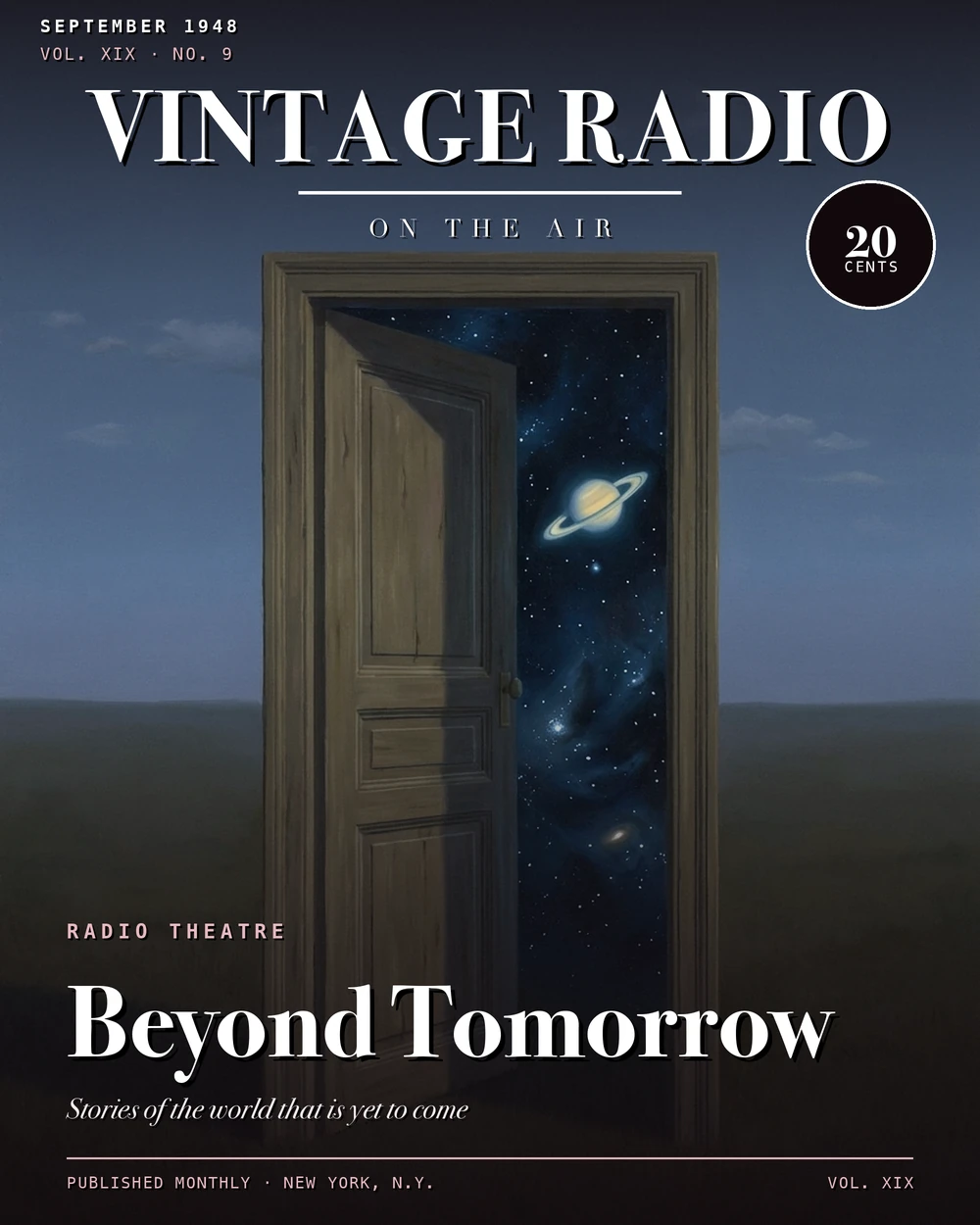
Beyond Tomorrow
So Close to Being First
Beyond Tomorrow occupies a frustrating place in radio history: it almost became the first science fiction series for adults on American radio, then was gone before most listeners knew it existed. The show was scheduled on CBS from April 5 to April 13, 1950 — three episodes in nine days — and there is real doubt among researchers about whether any of those broadcasts actually went out as announced, or whether the network pulled the plug at the last minute and slotted in something else. The transcription discs survive; the airing itself is uncertain.
The timing was brutal either way. Mutual's 2000 Plus had quietly premiered on March 15, beating everyone to the punch as the first adult science fiction series on American radio. Then NBC launched Dimension X on April 8 — three days after Beyond Tomorrow's announced debut — and that head-to-head competition was cited as a direct factor in CBS dropping the show. The Science Fiction Encyclopedia adds another piece: CBS already had Suspense running anthology material with fantastic elements, and the network saw little reason to carry a second program in similar territory.
The show had been in development well before those April broadcasts. An audition episode was recorded on February 23, 1950, under the title Beyond This World, and that same pilot later circulated as The Outer Limit. By the time CBS actually put the series on the schedule, the window had already started to close.
The People Behind It
For a series that barely made it out the door, Beyond Tomorrow assembled a serious creative team. John W. Campbell Jr. — editor of Astounding Science Fiction since 1937 and the central editorial figure of the Golden Age — was credited as consultant-host. Campbell had shaped the careers of Robert Heinlein, Isaac Asimov, Theodore Sturgeon, A. E. van Vogt, and Arthur C. Clarke, and two of those writers supplied source stories for the series itself. Interestingly, despite the "host" billing, researchers who have gone through the surviving audio find no trace of Campbell's voice in any of the three episodes; the closing credits call him "technical consultant" on one and "program consultant" on another. The host confusion likely traces back to collectors mixing these recordings up with Exploring Tomorrow, the 1957–58 Mutual series Campbell genuinely did host.
The production was handled by Mitchell Grayson and William N. Robson, sharing producer-director duties. Henry Sylvern composed the music, and the show leaned on futuristic sound effects as part of its sonic signature.
The Cast
The three actors named in connection with Beyond Tomorrow were each well-established radio performers. Everett Sloane brought the precise, distinctive vocal quality he had honed in the Orson Welles Mercury productions. Bret Morrison was at that moment the voice of The Shadow, one of radio's most recognizable roles, and he appeared in "Incident at Switchpath" as Professor Sikes, opposite Michael O'Day as James Kent. Frank Lovejoy had built a reputation across dramatic anthology programs. Three episodes was barely enough to put that talent to work.
The Stories
The three scripts pulled from exactly the kind of pedigree Campbell's name implied. Episode one, "Requiem," adapted Robert A. Heinlein's short story of the same name, first published in the January 1940 Astounding. Episode two, "Incident at Switchpath," came from Theodore Sturgeon's "The Sky Was Full of Ships" (Thrilling Wonder Stories, June 1947). Episode three reused the audition script, "The Outer Limit," an original radio play by Graham Doar (1912–1985) about a test pilot's encounter with a UFO — a story Doar had also placed in The Saturday Evening Post on December 24, 1949.
That third script has a strange afterlife. Dimension X also opened its run with an adaptation of Doar's "The Outer Limit," prompting one researcher's quip that it may be the most-used science fiction story in radio. The overlap ran deeper than the pilot, too: "Requiem" was later produced for Dimension X as well. The two competing series were drawing from the same well, and the well was Campbell's magazine.
The show's opening announcement promised stories "drawn from the vast library of science fiction, where anything is possible, and possibly may happen... to you!"
What It Left Behind
Beyond Tomorrow didn't get the chance to define itself. Three episodes is barely enough to establish a format, let alone an audience. Dimension X ran for fifty episodes over two years and became the benchmark for science fiction radio in that era. Whether Beyond Tomorrow could have competed on those terms is impossible to know — listeners who have heard the surviving discs tend to rate it on par with what Dimension X was producing, working from the same pool of writers and ideas. What's clear is that CBS had the pieces in place — the cast, the creative team, the editorial pedigree — and simply ran out of runway before any of it could take hold.